Is Exposed Brickwork A Lead Hazard?
If you live in a charming older home with an exposed brick wall, or you're gearing up for a weekend masonry project—you might wonder if brick poses a lead risk. The short answer? Plain clay bricks, when they are fully intact and in good shape, are practically harmless—as long as no one is licking them (I’ll come back to this later). The glazes, old paint coatings, and dust generated during renovations are a different story. But as with all things lead, it’s important to ask not just what is there, but how we are interacting with it.
Let’s break it down into the materials of possible concern, and then for each material, we can talk about the treatment and interaction piece. When contemplating a brick wall, we find:
The brick itself
The mortar that holds it together into a wall
Coatings and other substances such as glazes, paint, sealants, etc.
So, the brick itself:
Standard unglazed clay bricks contain 10-50ppm lead. Natural clay soils naturally contain lead at levels reflective of the Earth’s crust baseline. Firing at extremely high temperatures locks this lead into the ceramic body of the brick.
Enter Bob the Builder, Father Time and their good friend Dust.
When cutting or sanding bricks, and as bricks degrade over time due to fluctuations in humidity and temperature, dust is created. As long as professionals or DIY-ers are taking proper measures (wet-cutting, HEPA vacuums, taping off other areas of the home…) the dust from brick installation or renovation is manageable. But consumption or inhalation of this dust (say by small, potentially mouthy children) does pose the risk of lead poisoning.
The image below features "spalling" brickwork (this is the term for bricks flaking off due to frost cycles and high humidity). We've all seen walls like this.
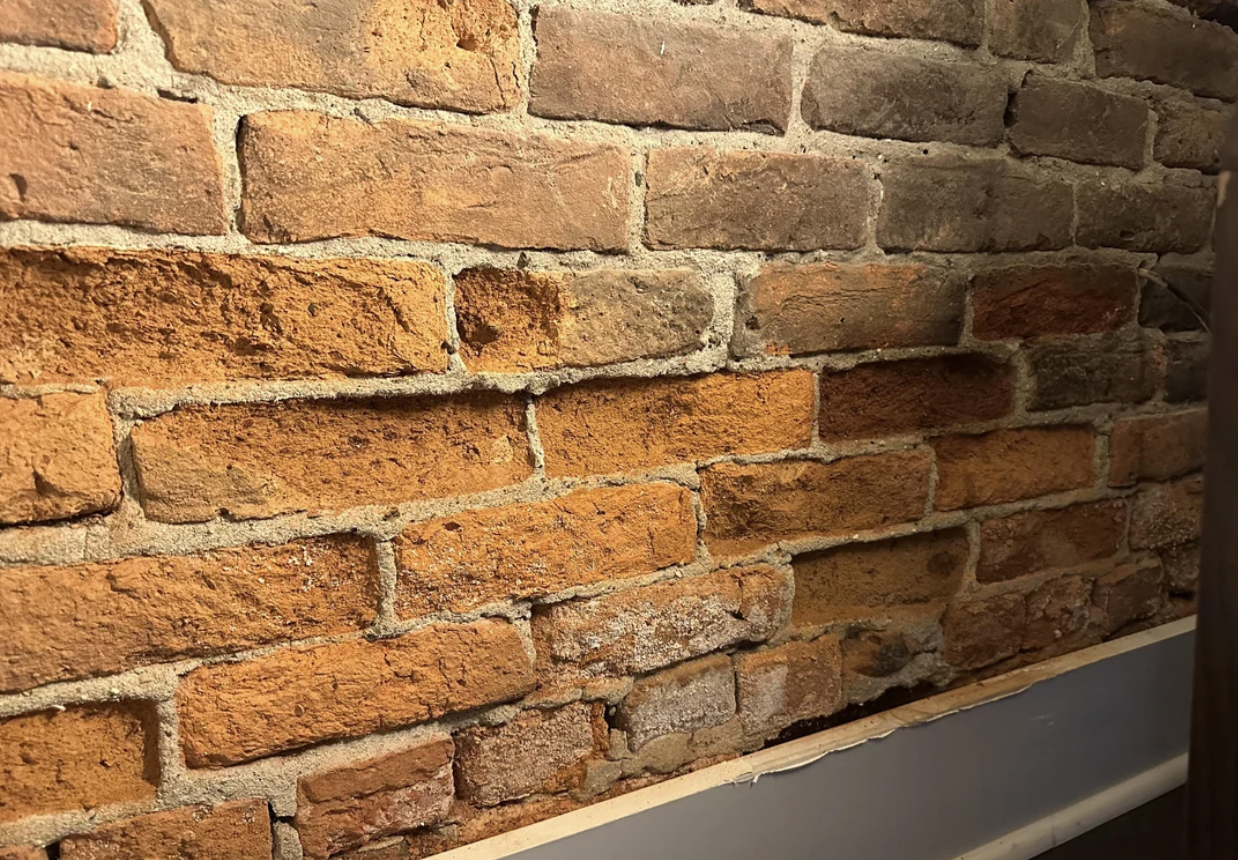
NOTE TO PARENTS: There is a strangely common phenomenon of children, particularly babies and toddler who LOVE to lick brick (told you I'd come back to this). My daughter is one of these creatures. LICKING BRICK IS NOT SAFE. If it happens once or twice, fine, but if this behavior is consistently repeated, it could ultimately result in an EBLL (elevated blood lead level).
The mortar: For those not up on their masonry terminology – mortar is the cement-like stuff between the bricks that holds them all together. Standard mortar composed of sand, hydrated lime, and Portland cement contains negligible intrinsic lead (<20 ppm)
*Caveat here: there are examples from history of lead being mixed into mortar, and, anecdotally, I have heard of lead-contaminated sand being used as well. Anytime you’re using materials mined from the earth’s crust, there’s the possibility of lead, but especially when manufacturers source materials from high-industry areas (sand from a riverbed downstream from a factory, etc), the risk skyrockets.
In the case of historic mortar, we’re talking in the range of 100-5,000+ ppm. The big thing about mortar is that it is highly porous, and therefore HIGHLY absorbent. So, over time, leaded gasoline exhaust, or lead dust from degrading materials in the environment (such as roof flashing or lead paint) makes its way into the mortar, and the mortar then becomes a repository for lead, which can be hazardous as it degrades.
Standard mortar composed of sand, hydrated lime, and Portland cement contains negligible intrinsic lead (<20 ppm). However, historic mortar joints frequently absorb surrounding environmental heavy metals or become contaminated by deteriorating lead coatings.
Brick treatments and additional masonry ingredients:
This is where lead lurks in high concentrations.
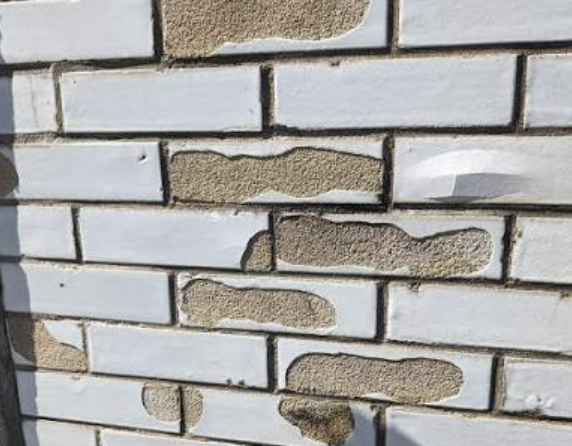
Historic Glazed Bricks (5,000 – 50,000+ ppm): Prior to modern environmental regulations, decorative glazed bricks—often found on historic commercial facades, subway stations, and institutional interiors—utilized lead oxide as a flux to achieve bright colors and low melting temperatures. These glazes frequently contain lead concentrations exceeding 0.5% (5,000 ppm) to over 5% by weight. *See the second image below for an example of white glazed victorian brickwork.
Painted or Sealed Brickwork (>5,000 ppm): In pre-1978 residential construction, interior and exterior brick walls were routinely painted with lead-based paints, limewash, or heavy-metal sealers.
Lead seal and similar lead-additive products are sometimes used in lieu of mortar in places where builders want the structure to be able to forgive some shifting over time, including windows that meet brick or stone. This is basically just straight up lead.
Here is a picture of delaminating/deteriorating glaze in Victorian brickwork:
And here is a video of how builders might use lead seal:
https://www.facebook.com/reel/1281153386472038
Recommended Mitigation Actions
Pre-Renovation Testing: Test your brick with X-ray fluorescence (XRF) or laboratory chip analysis prior to any grinding or sanding. You can send such samples to me, this kind of thing is included in your Club Lead membership! (Remember, even if a brick looks unpainted, its history could be hiding something. Many older bricks are re-used, and sandblasting off old paint doesn't remove the contamination from the underlying material.)
Dust Control: Use HEPA-filtered shroud extractors during mortar raking, and mandate wet-cutting methods OUTSIDE on jobsites.
In-Home Encapsulation: Clean deteriorating historic brickwork with HEPA vacuums and seal chalking surfaces with vapor-permeable masonry sealers rather than using dry abrasive removal.
Citations:
Karrari, P., Mehrpour, O., & Abdollahi, M. (2012). A systematic review on status of lead pollution and toxicity in Iran; Guidance for preventive measures. DARU Journal of Pharmaceutical Sciences, 20(1), 2. https://doi.org/10.1186/1560-8115-20-2 Cited by: 314
Meeker, J. D., Cooper, M. R., Lefkowitz, D., & Susi, P. (2009). Engineering Control Technologies to Reduce Occupational Silica Exposures in Masonry Cutting and Tuckpointing. Public Health Reports®, 124(1_suppl), 101–111. https://doi.org/10.1177/00333549091244s112 Cited by: 69
Thurtle, N., Greig, J., Cooney, L., Amitai, Y., Ariti, C., Brown, M. J., ... & Dargan, P. I. (2014). Description of 3,180 Courses of Chelation with Dimercaptosuccinic Acid in Children ≤5 y with Severe Lead Poisoning in Zamfara, Northern Nigeria: A Retrospective Analysis of Programme Data. PLoS Medicine, 11(10), e1001739. https://doi.org/10.1371/journal.pmed.1001739 Cited by: 66
Weinstein, M., Susi, P., & Goldberg, M. (2016). The power of local action in occupational health: the adoption of local exhaust ventilation in the Chicago tuckpointing trade. International Journal of Occupational and Environmental Health, 22(2), 142–150. https://doi.org/10.1080/10773525.2016.1187476 Cited by: 3
Whiteside, T. E., Qu, W., DeVito, M. J., Brar, S. S., Bradham, K. D., Nelson, C. M., ... & Kurtz, D. M. (2020). Elevated Arsenic and Lead Concentrations in Natural Healing Clay Applied Topically as a Treatment for Ulcerative Dermatitis in Mice. Journal of the American Association for Laboratory Animal Science, 59(2), 212–220. https://doi.org/10.30802/aalas-jaalas-19-000068 Cited by: 4